Kenyans give more readily than almost anyone else on earth. The World Giving Report 2025, published by the Charities Aid Foundation with the Kenya Community Development Foundation, found that 86% of Kenyans gave money to a cause in 2024 — well above the global average of 64% and the African average of 72%. Nearly half volunteered their time as well, averaging 20.6 hours each.
What that generosity does not come with is an easy way to check who deserves it. The same report found that 61% of Kenyans want impact information before they donate, and 47% said they would give more if the charity sector were better regulated. Those two numbers describe a real gap: the willingness is there, the confidence is not.
This guide is written to close that gap. It covers how giving actually works in Kenya, how to verify an organisation before you send a shilling, what different kinds of support fund, and how to give in ways that have nothing to do with money. We have used our own details as the worked example throughout — and we would encourage you to run the same checks on us that you would run on anyone else.
How to donate to an NGO in Kenya: the main channels
Most giving in Kenya moves over mobile money, for the simple reason that most money in Kenya moves over mobile money. Safaricom reported 40 million monthly active M-Pesa customers as of March 2026, up from 9.8 million in 2012, and 21.9 billion transactions worth KSh 20.2 trillion in the six months to September 2025. An organisation without a Paybill or Till is, in practice, an organisation that is hard to give to.
There are four channels worth knowing:
- M-Pesa Paybill or Till. Instant, traceable on both sides, and works from any handset. Best for individual gifts of any size.
- Bank transfer. Slower but better for large gifts, corporate giving, and anything that needs a formal paper trail for audit or grant reporting. International donors will need the SWIFT code.
- In-kind goods. Sanitary products, school supplies, uniforms, books, equipment. Genuinely useful when it matches a live need, and a burden when it does not — always ask first.
- Time and skills. Often the most valuable thing a professional can give, and the most under-supplied.
For reference, the Global Women Impact Foundation receives donations through M-Pesa Paybill 400200, Account 202433, and through Co-operative Bank account 01100550267001, Nkrumah Branch, Mombasa, SWIFT KCOOKENA. If you would rather know who is behind the Paybill before you use it, that is the better instinct — start with who we are and how we are governed.
How to pay a Paybill on M-Pesa, step by step
Safaricom's menu wording shifts between handsets, the SIM toolkit, and the M-PESA app, so treat these as the shape of the process rather than the exact words on your screen:
- Open the M-PESA menu on your phone, or the M-PESA app.
- Select Lipa na M-PESA.
- Select Pay Bill.
- Enter the business number. For GWIF that is 400200.
- Enter the account number. For GWIF that is 202433.
- Enter the amount you want to give.
- Enter your M-PESA PIN and confirm.
- Keep the confirmation SMS. It is your receipt, and it is what lets an organisation trace and acknowledge your gift.
If the confirmation SMS names an organisation you have never heard of, stop and query it before sending anything further. Paybill numbers are sometimes shared across a bank's clients with the account number doing the routing, which is normal — but the name on the confirmation should still make sense.
Five checks before you give
This is the part worth bookmarking. None of these checks takes more than a few minutes, and together they filter out most of what should worry you.
- Check the organisation is registered, and under what. Kenya's regulatory ground shifted recently: the Public Benefit Organisations Act, 2013 finally came into force on 14 May 2024 through Legal Notice No. 78 of 2024, repealing the NGO Co-ordination Act of 1990 and creating the Public Benefit Organisations Regulatory Authority (PBORA) as the sector's regulator. Ask an organisation what it is registered as and when. Organisations registered under the old law are deemed registered as PBOs but had up to one year to formalise it, so "we are transitioning" is a legitimate answer in a way that "we are not registered" is not.
- Ask to see audited accounts. Under the PBO Act, every registered entity must submit audited accounts within six months of its financial year-end — and critically, all of them must, regardless of how much funding they handle. Under the repealed Act only organisations earning KES 1 million or more had to. An organisation that cannot produce accounts is failing a legal obligation, not just a courtesy request.
- Look for identifiable beneficiaries. The Act defines a public benefit organisation as one that benefits the public exclusively, with no private benefit to its directors or members, and with identifiable, verifiable beneficiary groups. In plain terms: can they tell you which schools, which wards, which women? Vagueness at this level is the single most reliable warning sign.
- Check that the money and the mission line up. Ask what proportion of funds reaches programmes, and ask what the last year's largest single expense was. You are not auditing them. You are finding out whether anyone in the organisation can answer the question.
- Verify the payment details independently. Get the Paybill from the organisation's own website or from a phone call to a listed number — never from a forwarded WhatsApp message, a social media comment, or a poster photograph. Impersonation of real charities is the most common way donors in Kenya lose money.
The question worth asking is not "is this organisation good?" but "can this organisation show me?" A good organisation will not mind the question. That reaction, more than any document, is the test.
You can find the register and current registration requirements at the PBO Regulatory Authority, with applications running through the PBORA e-Citizen platform. Registration now takes 60 days, down from 90 under the repealed Act, and applications must include the constitutive document, founders' names and addresses, physical and postal addresses, details of the public benefit activities, and the prescribed fee.
Why the scrutiny matters more than it used to
Kenya's NGO sector is large and heavily externally funded. A 2020 report from the Government of Kenya, UNDP and the NGO Coordination Board counted over 11,200 registered NGOs with sector funding of KSh 166 billion in 2018/19 — 88% of it originating outside Kenya.
That dependence has two consequences for a domestic donor. First, local giving carries weight out of proportion to its size, because it is the part of an organisation's income that is not tied to a foreign funder's shifting priorities. Second, a sector that raises most of its money abroad has historically been accountable mostly to people who are not in the room. Kenyan donors asking Kenyan questions changes that.
International organisations, incidentally, now face a specific requirement: at least one-third Kenyan directors resident in Kenya, and a Kenya office, unless they are exempted and issued a permit. It is a reasonable thing to ask a foreign-founded charity about.
What your donation actually funds
Be wary of any organisation that tells you precisely what a given amount buys without hesitation. Costs move with procurement, transport, school term dates and exchange rates, and a figure quoted confidently in January is often wrong by August.
What we can describe honestly is the shape of it. At GWIF, giving clusters around four things:
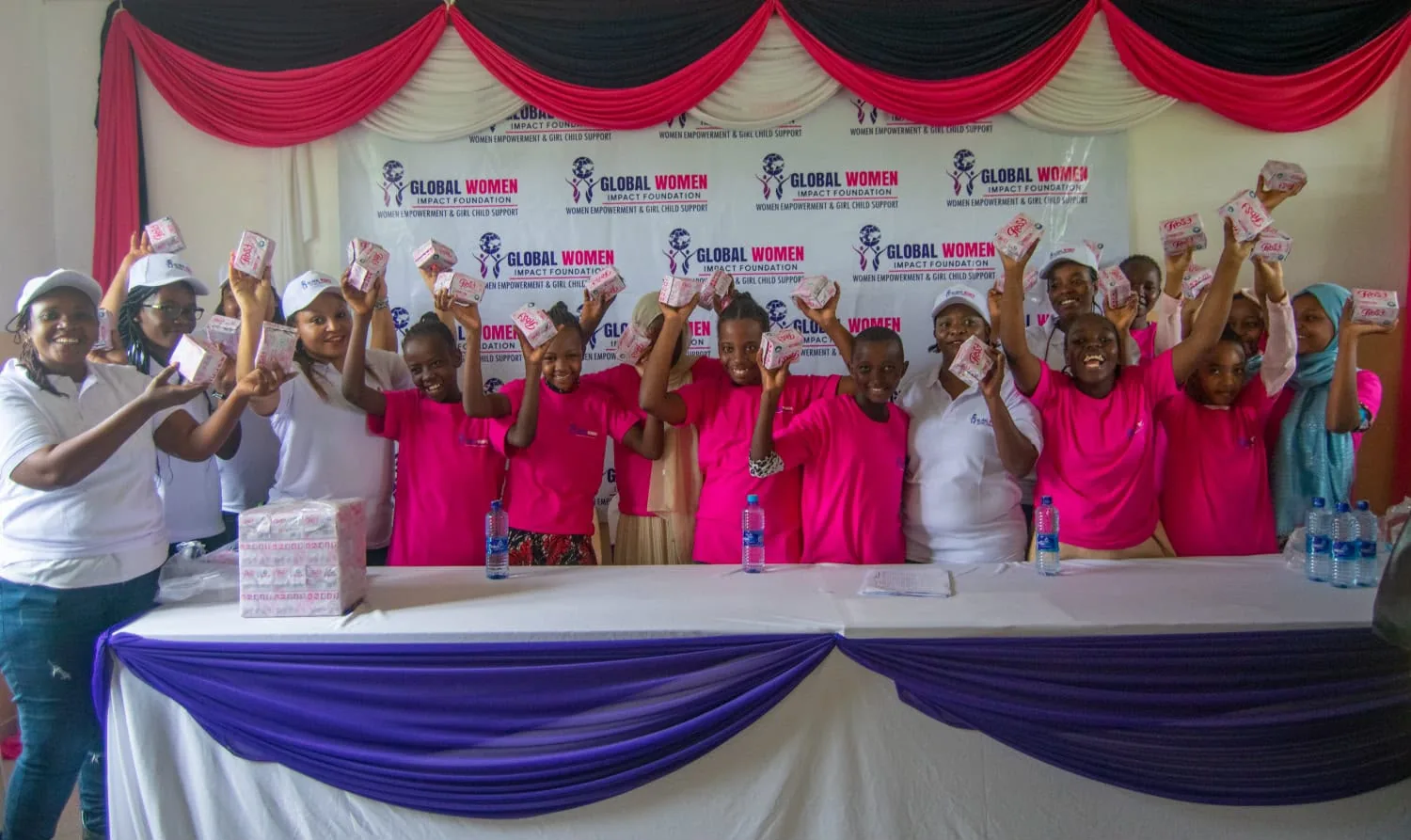
- Dignity kits. Sanitary products distributed through partner schools, alongside menstrual health education. A meaningful unit here is a term's supply for a class rather than a single pack — this is the intervention behind our work on period poverty in Kenya.
- School costs. Not tuition, which is waived at public schools, but the costs that actually push girls out: uniforms, books, meals, transport, and PTA levies. The mechanics of that are covered in our piece on why girls drop out of school in Kenya.
- Micro-grants and training for women starting or growing small enterprises, which matters given how narrow formal credit access remains — see our guide to funding for women entrepreneurs.
- Mentorship and advocacy, the slowest-returning and least fundable of the four, and the one most dependent on unrestricted giving.
If you want current per-unit costs before deciding, ask us and we will send the actual figures rather than a marketing round number. You can also see the full set of programmes a gift is distributed across.
What about tax?
Tax treatment of charitable donations in Kenya depends on the receiving organisation's exemption status and on your own circumstances, and the rules are not something to take from a blog post. Check current Kenya Revenue Authority guidance, ask the organisation directly whether it holds a valid tax exemption, and speak to an accountant if the gift is large enough for the answer to matter. Any organisation that promises you a tax benefit without qualification is telling you something it cannot know.
Give, or give differently
Money is the most flexible thing you can give, but it is not the only thing, and for some people it is not the best thing.
- Cash, one-off or monthly. Recurring gifts are worth disproportionately more than their size, because they let an organisation commit to a school term rather than hope. Kenyan givers are already inclined this way — 21% of those who gave in 2024 gave twelve or more times, against 13% globally.
- In-kind, matched to a stated need. Ask what is short before you buy. Unrequested goods create storage and distribution costs that can exceed their value.
- Skills. Accounting, legal work, monitoring and evaluation, photography, web development, procurement. Professional time closes gaps that small organisations cannot afford to fill.
- Time. Nearly half of Kenyans volunteered in 2024. Mentoring, distribution days and community sessions all run on people showing up.
- Introductions. A connection to a school, a SACCO, a corporate CSR budget or a supplier is frequently worth more than a cheque.
If any of that is something you can offer, tell us what you have in mind — or read more of our research and field writing first and decide afterwards. And whichever organisation you choose, in Kenya or elsewhere, run the five checks. The good ones will thank you for it.