A girl finishes Form Four in Kilifi with good grades and no idea who to call. That gap — between leaving school and finding a foothold — is where most of Kenya's leadership potential quietly disappears.
Kenya is not short of ambition or of public support for women's leadership. What it is short of is the connective tissue: the people who make an introduction, explain how a bursary application actually works, or tell a young woman that the interview panel is not as frightening as it looks. Mentorship is that tissue. It is unglamorous, it is slow, and it is one of the few things ordinary people can offer that genuinely moves someone forward.
This guide sets out what the leadership gap looks like in numbers, why a constitutional rule meant to close it has stalled, and then gets practical: how a young woman can find a mentor, and how anyone with a decade of working life behind them can become one.
Women in leadership Kenya statistics: where things actually stand
Start with Parliament. The Inter-Parliamentary Union's Parline database records 80 women among the 348 members of Kenya's National Assembly — 23.0%, on data as of December 2025. The Senate does better at 21 women of 67 members, or 31.3%.
Those figures are not far off UN Women's own reading, which put women at 23.3% of parliamentary seats as of February 2024. Both point the same way: roughly one seat in four.
The corporate picture is slightly brighter and moving. The National Gender and Equality Commission audited companies listed on the Nairobi Securities Exchange between 2 and 16 April 2024, analysing 55 of the 65 listed firms. It found women held 27.6% of board seats — 143 of 517 — up three percentage points from 25% in 2022.
Progress, but thin. In the same NGEC audit, only 22 companies (40%) met the two-thirds board composition threshold, five companies (9%) had no women on their boards at all, and just seven companies (12.7%) had a woman as Chief Executive Officer.
In the public sector, Afrobarometer's 2024 research found women occupy 37% of public institution leadership roles, while men hold up to 75% of positions in some parastatals.
The two thirds gender rule Kenya has never implemented
The 2010 Constitution set a clear floor: no more than two-thirds of the members of elective or appointive bodies may be of the same gender. It also reserved seats — 47 National Assembly seats for women, each elected from a single-member county constituency, and 16 reserved Senate seats.
The reserved seats work. The general principle does not, because Parliament never passed the law needed to give it effect. IPU Parline records plainly that no implementing legislation has been enacted to date.
So Kenya has a constitutional commitment, a partial mechanism that delivers roughly a quarter of the National Assembly, and no legal route to the rest. The remainder has to be won seat by seat, boardroom by boardroom, by women who are ready when the opportunity comes.
That readiness is not automatic. It is built over years, usually by someone who took an interest.
Kenyans want this. The pipeline is what is missing
Public opinion is not the obstacle. Afrobarometer's 2024 survey of 2,400 Kenyans, conducted in April and May 2024 and published in July 2025, found 81% say women should have the same chance as men of being elected to public office. Support runs at 87% among women and 76% among men.
That figure is down five points from a 2021 peak of 86%, which is worth watching. But four in five Kenyans is a strong mandate by any measure.
The blockage sits earlier, in work and education. Afrobarometer found 34% of working-age women in employment against 47% of men. The barriers respondents named were practical rather than ideological: 28% cited a lack of remote or flexible work, 21% pointed to employer preference for men, and 18% named insufficient childcare. Nineteen percent reported women being prevented from taking employment by spouses or family.
Education tells a similar story of a gap that opens late. Afrobarometer recorded secondary attainment at 40% for women and 43% for men — close. At post-secondary level it widens sharply: 21% of women against 30% of men. UNESCO's Global Education Monitoring Report team put upper secondary completion in 2024 at 45.6% for girls and 47.2% for boys.
So girls stay roughly level through school and then fall away afterwards. That is a transition problem, and transition problems respond to people, not policy alone.
Girls do not drop out of leadership. They drop out of the corridor that leads to it — somewhere between the last school bell and the first serious opportunity.
Mentorship programmes for young women in Kenya: what they can and cannot do
Be honest about this. Nobody can promise that a mentor produces a specific percentage improvement in anything, and any organisation quoting you a figure of that kind should be asked where it came from.
What mentors consistently report is narrower and more believable. They shorten the time a young woman spends guessing. They make the unwritten rules visible — how to ask for a reference, what a panel interview is testing for, when to negotiate. They provide a second opinion from someone with no stake in the outcome except the young woman's progress.
They also provide something structural: a witness. Someone who notices when a young woman stops showing up, and asks why. In a country where 15% of adolescent women aged 15-19 have ever been pregnant, according to the Kenya Demographic and Health Survey 2022, that early notice matters.
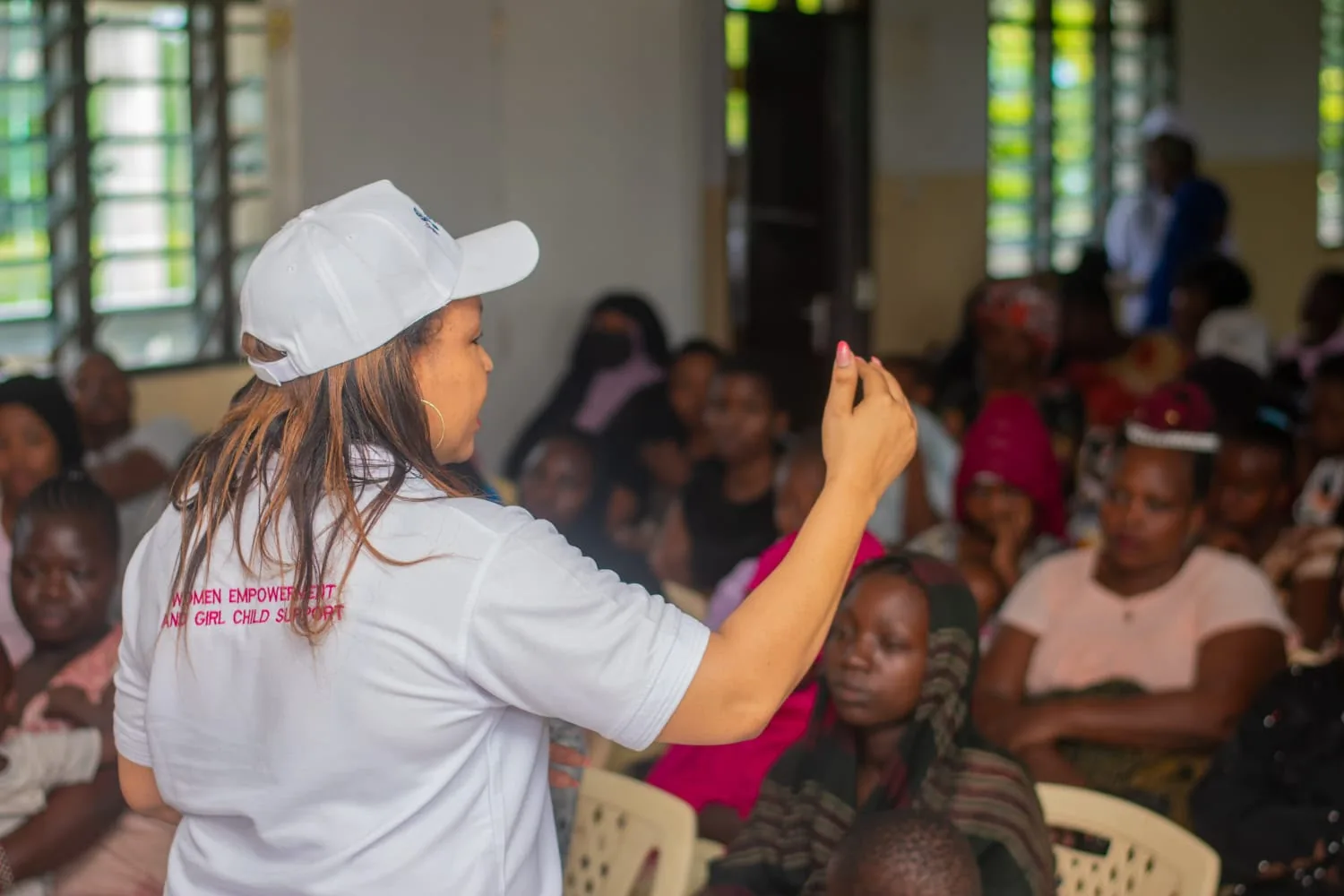
At GWIF, Mentorship Circles pair experienced professionals with young women in structured peer and expert groups, and the Girl Child Leadership & Mentorship Academy runs cohort orientations so that every intake starts with a shared understanding of what the year involves. You can see how this sits alongside our other work on the programmes page and how the organisation is governed in our structure.
How to find a mentor as a young woman in Kenya
You do not need a formal programme to start, though a programme helps if you have no network to draw on.
- Look sideways before you look up. A woman three or four years ahead of you remembers the details of the step you are taking. A chief executive does not.
- Use the institutions you already touch. Church and mosque groups, chamas, alumni networks, county youth offices, professional bodies and TVET placement officers all know people.
- Ask for something specific. "Will you mentor me" is a heavy request. "Could I ask you fifteen minutes of questions about how you got into procurement" is one most people say yes to.
- Apply to a structured programme if the informal route is closed. Structured cohorts exist precisely for young women whose families and neighbourhoods do not contain the professions they are aiming at.
- Expect to do the follow-up. Mentors are busy. The relationships that survive are the ones where the mentee books the next conversation.
If school fees or a lack of learning materials are the immediate obstacle rather than guidance, start with our piece on the barriers keeping Kenyan girls out of school — mentorship works best once a girl is actually in a classroom or a workshop.
What a first mentoring conversation should actually cover
The first meeting sets the tone. It should be short, roughly forty-five minutes, and it should end with something written down. Cover these, in this order.
- Introductions with substance. Not job titles. How each of you got to where you are, including the detours and the years that did not work out.
- What the mentee actually wants in the next twelve months. One or two goals, concrete enough to know whether they happened. "Get a job" is not one. "Complete the attachment and get a written reference" is.
- The honest constraints. Money, distance, transport, family expectations, caring responsibilities, health. A mentor who does not know about the two-hour commute will give useless advice.
- What the mentor can and cannot offer. Time, introductions, review of applications, sector knowledge. Say clearly if you cannot offer money or a job, because unspoken assumptions here damage the relationship.
- Boundaries and logistics. How often you will meet, on which channel, what response time is realistic, and what happens if someone needs to cancel.
- One small action each before the next meeting. The mentee drafts a CV; the mentor sends two contacts. Momentum comes from small, kept promises.
- The next date, agreed before you part. An open-ended "let's stay in touch" is how most mentorships end.
Write the goals and the two actions in a message straight after the meeting so both of you have the same record.
How to become a mentor for girls in Kenya
You are more qualified than you think. You do not need to be senior, wealthy, or in a glamorous profession. You need about ten years of adult life you can describe honestly, and time you will genuinely protect.
- Decide what you are offering. Career-specific guidance, exam and revision support, entrepreneurship, or general life and confidence mentoring. Narrow is better than broad.
- Commit to a realistic cadence. One hour a month, kept for a year, beats weekly promises abandoned in March.
- Join a structured programme rather than freelancing. Structure gives you safeguarding rules, a coordinator to escalate to, and a defined end point.
- Complete the orientation. Programmes that skip induction produce mentors who overstep or disappear. Cohort orientation exists to prevent both.
- Learn the referral routes. You are not a counsellor, a lawyer or a lender. Know where to send a young woman facing violence, and read our guide on where to get help after gender-based violence in Kenya before you start.
- Keep records and keep boundaries. Meet in public or online, keep a coordinator informed, and never handle a mentee's money.
If your strength is business rather than career guidance, mentoring a young woman through a first enterprise is often the most useful thing you can do. Our guide to funding for women entrepreneurs in Kenya covers the ground a business mentor should be able to walk a mentee through.
Leadership training for women in Kenya works best when it is paired
Training on its own has a short half-life. A workshop teaches public speaking; a mentor tells you which forum to speak at, and turns up to watch.
The pairing matters because most of what stops a capable young woman is not a skills deficit. It is not knowing that the opportunity exists, not knowing anyone who has done it, and having nobody to check a decision with at nine o'clock at night.
Kenya's two-thirds rule will eventually be legislated or it will not. Either way, the women who fill those seats will be the ones who were prepared, connected and encouraged a decade earlier. That work is happening now, in ordinary conversations, in Mombasa and Kilifi and Nairobi and everywhere else.
How to get involved
If you want to mentor, we will ask about your sector, the time you can genuinely commit, and which age group suits you, then place you in a Mentorship Circle or a Girl Child Leadership & Mentorship Academy cohort with an orientation before you meet anyone.
If you are looking for a mentor, tell us where you are, what stage you have reached, and what you are trying to do next. There is no fee to join, and you do not need connections to apply.
Write to info@globalwomenimpactfoundation.org, call +254 723 428 105, or use the form on our contact page. Our office is at Wimpy House, Moi Avenue, Mombasa, and we work across Kenya with a strong presence along the Coast.