Period poverty is not simply a shortage of pads. It is a shortage of money, water, private toilets and honest conversation, all arriving at once, in the same month, in the life of the same girl.
Kenya has stronger law on this than most countries in the world. It also has a stubborn gap between what is written in that law and what is actually in the hands of a girl in Class 7 on a Monday morning.
This article sets out what is genuinely known about period poverty in Kenya: the verified statistics, what the government has delivered, what it has not, which interventions have evidence behind them, and what a reader can usefully do. Where a figure is an illustration rather than a published statistic, we say so plainly.
What period poverty in Kenya actually means
Period poverty describes the inability to afford or access menstrual products, together with the water, sanitation, privacy and information needed to manage a period safely and with dignity.
In practice it looks like a girl using a strip of old blanket, an offcut of mattress foam, cotton wool or newspaper. It looks like her sitting at the back of the class, refusing to stand up. It looks like a mother deciding between a packet of pads and a packet of unga.
The Ministry of Health is blunt about the scale. Its Menstrual Hygiene Management Policy 2019-2030 records that up to 65% of women and girls in Kenya cannot afford sanitary pads.
That one number settles the framing. This is not a niche welfare concern affecting a small group. It is close to a majority experience.
Period poverty Kenya statistics: what the evidence shows
Ministry of Health research from 2016 found that 54% of Kenyan girls experience challenges accessing menstrual products, and that 65% lack sustainable access to safe products. The word sustainable is doing real work in that sentence. A single donation in March is not access in August.
More recent evidence points the same direction. A survey of 9,480 respondents carried out between October 2024 and February 2025 by the Nguvu Collective together with the Kenya Women Parliamentary Association found that four in 10 Kenyan women cannot afford sanitary towels.
On schooling, UNFPA Kenya reports that girls miss an average of three to four school days every month because they cannot afford pads. UNICEF estimates that one in 10 school-age African girls do not attend school during menstruation.
We have deliberately left out two much larger absence claims that circulate widely in Kenyan and international coverage. Neither could be traced to a primary source, so neither appears here. The verified figure of three to four days a month is serious enough on its own, and advocacy built on numbers that cannot be defended eventually damages the cause it is meant to serve.
The cost of sanitary pads in Kenya, honestly calculated
The Nguvu Collective and KEWOPA survey gives the clearest available picture of what households actually pay. Among respondents, 74.31% buy pad packets priced between KSh 50 and KSh 100. A further 18.77% spend between KSh 101 and KSh 150, and 4.96% spend over KSh 150.
What follows is an illustrative calculation, not a published statistic. If a girl needs two packets in a cycle and buys at the most common price band of KSh 50 to KSh 100, she is looking at roughly KSh 100 to KSh 200 a month, or something in the range of KSh 1,200 to KSh 2,400 across a year. Heavier flow, a longer period, or two or three menstruating people in one household moves that figure again.
We publish the working rather than a single headline number because no verified national figure for the annual cost exists, and inventing one would be easy and dishonest.
Now set that against income. The World Bank found in 2015 that 36.8% of Kenyan families live below the 1.90 US dollar a day poverty line. For a household at that level, a monthly pad budget is not a rounding error. It is a direct trade-off against food, paraffin, soap or matatu fare, and it is a trade-off that recurs every single month.
Kenya's tax policy has, to its credit, been ahead of the world. According to The Fuller Project, Kenya was the first country in the world to abolish VAT on period products, back in 2004. In 2024 an eco-tax on pads was proposed, Parliament amended it to exclude locally made pads, and President Ruto ultimately withdrew the tax proposals.
That was a real save. It is also a reminder of how fast affordability can be undone by one line in a finance bill, and why advocacy has to keep watch every budget cycle.
Kenya wrote one of the strongest menstrual health laws in the world and then let the budget for it fall. The space between the promise and the funding is where a girl's education quietly disappears.
The government free sanitary towels programme Kenya promised
The legal commitment is unambiguous. The Basic Education (Amendment) Act No. 17 of 2017 requires the government to provide free, sufficient, quality sanitary towels to every girl registered in a public basic education institution. Kenya also has a Menstrual Hygiene Management Policy running from 2019 to 2030, published by the Ministry of Health in 2019, which is more than many countries in the region can say.
Delivery actually predates the Act. According to Ministry of Education figures compiled by the African Women in Journalism Project, the national sanitary towel programme began in the 2011/2012 financial year under the Gender Policy in Education of 2007, initially targeting girls in classes 6 to 8 in public primary schools.
Since it started, roughly 7.9 million girls have benefited, and around KSh 3.49 billion has been allocated since 2011. Those are not trivial figures, and the programme deserves to be described accurately rather than dismissed.
The problem is the trend. The budget rose in the 2019/20 and 2020/21 financial years and was then reduced in 2021/22, even as enrolment continued to rise. A programme whose funding shrinks while its target population grows will leave girls out. That is arithmetic, not opinion.
Read the wording of the Act closely, too. The entitlement covers every girl registered in a public basic education institution. A girl who has already dropped out is not registered, and so is not covered by the very provision most likely to have kept her in school.
Pads alone fail without water, soap and a door that locks
Even a girl who receives free towels needs somewhere to use them.
UNICEF and WHO Joint Monitoring Programme data for 2023, cited by the African Women in Journalism Project, found that only 45.3% of girls have access to both clean water and soap for menstrual hygiene at school.
School sanitation surveys fill in the detail. In 2018, 32% of rural Kenyan schools had a private space where girls could change products. A 2014 assessment found that 33% had locks on toilet rooms. A 2014 study of 62 schools found that 60% had water for handwashing, but only 2% had soap.
Hold those three findings together and the picture is clear. A pad handed to a girl who has no lockable room, no water and no soap is a partial solution, and she knows it better than anyone. This is why our sanitary hygiene kit drives and school programmes are designed to sit alongside school-level hygiene support rather than function as a standalone handout.
Period poverty in Kenya is a child protection issue
The most serious consequence of period poverty is not the missed lesson. It is what a girl may be asked to do in order to avoid missing it.
The Ministry of Health's Menstrual Hygiene Management Policy records that 10% of young adolescent girls in Western Kenya admitted to transactional sex for pads.
The Nguvu Collective and KEWOPA survey found that 33.6% of respondents had personally faced, or been at risk of, sexual harassment, exploitation or abuse because they lacked access to menstrual products.
A third of respondents. That figure moves menstrual products out of the hygiene column and into the child protection column, and it connects directly to the wider landscape of gender-based violence in Kenya and where survivors can find help.
It also explains why organisations that only count packets distributed are measuring the wrong thing. The outcome that matters is whether a girl was ever put in a position where her body became the currency for a KSh 80 packet.
What actually works
Four things consistently show up in the evidence and in what we see across Coast Province and the wider country.
- Predictable supply rather than one-off drives. A girl menstruates every month, not once a term. Sustainable access was precisely the gap the Ministry of Health identified in 2016, and a photogenic single distribution does not close it.
- Products paired with water, soap and privacy. Given the WASH figures above, distribution that ignores the changing room and the handwashing point is doing half the job.
- Information that reaches boys, teachers and parents. Menstrual shame is enforced socially. It cannot be undone by speaking only to girls.
- Keeping the girl enrolled at all. Menstrual support is one strand within a broader set of barriers pushing Kenyan girls out of school, alongside fees, distance, care work and early marriage.
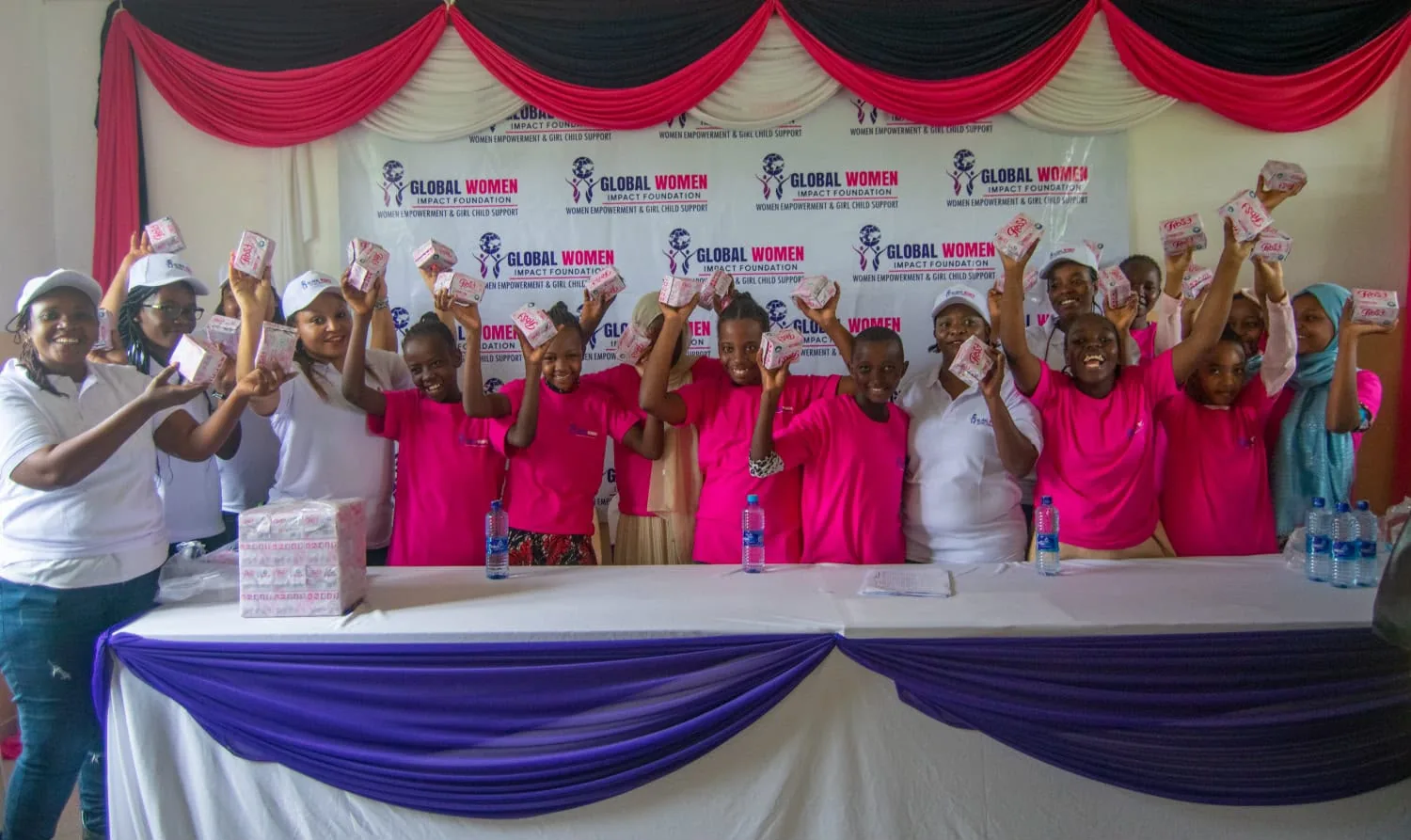
This is the reasoning behind how Global Women Impact Foundation is structured. Sanitary Hygiene Kit Drives address supply. Girls' Education Support addresses enrolment. Mentorship Circles exist because a girl who has an older woman she can ask a question is a girl who is far less likely to leave quietly. Women Entrepreneur Micro-Grants address the household income that determines whether the supply continues after we do. Gender-Rights Advocacy addresses the budget line.
What you can do
- Fund a term of supply rather than a single packet. Consistency is what changes attendance. Ask any organisation you support how many months of cover your gift actually buys.
- Give directly. Donations reach us via M-Pesa Paybill 400200, Account 202433, or Co-operative Bank account 01100550267001, Nkrumah Branch, Mombasa. If you have not given to a Kenyan NGO before, this walkthrough of donating by M-Pesa covers the steps.
- Ask your county and your MP about the sanitary towel budget line. The 2017 Act is a legal duty, not a favour. Budget scrutiny is something an ordinary constituent can do.
- Fund the unglamorous part. A lockable door, a tap and a bar of soap in a school changing room will do more for attendance than another photo of a donation handover.
- Talk to a girl you know, and to the boys around her. Silence is the cheapest thing sustaining this problem.
If you want to fund a school, partner with us, or discuss a corporate or diaspora giving programme, contact our Mombasa team. We will tell you what a term of supply costs for the specific school you are asking about, and what it will not solve on its own.